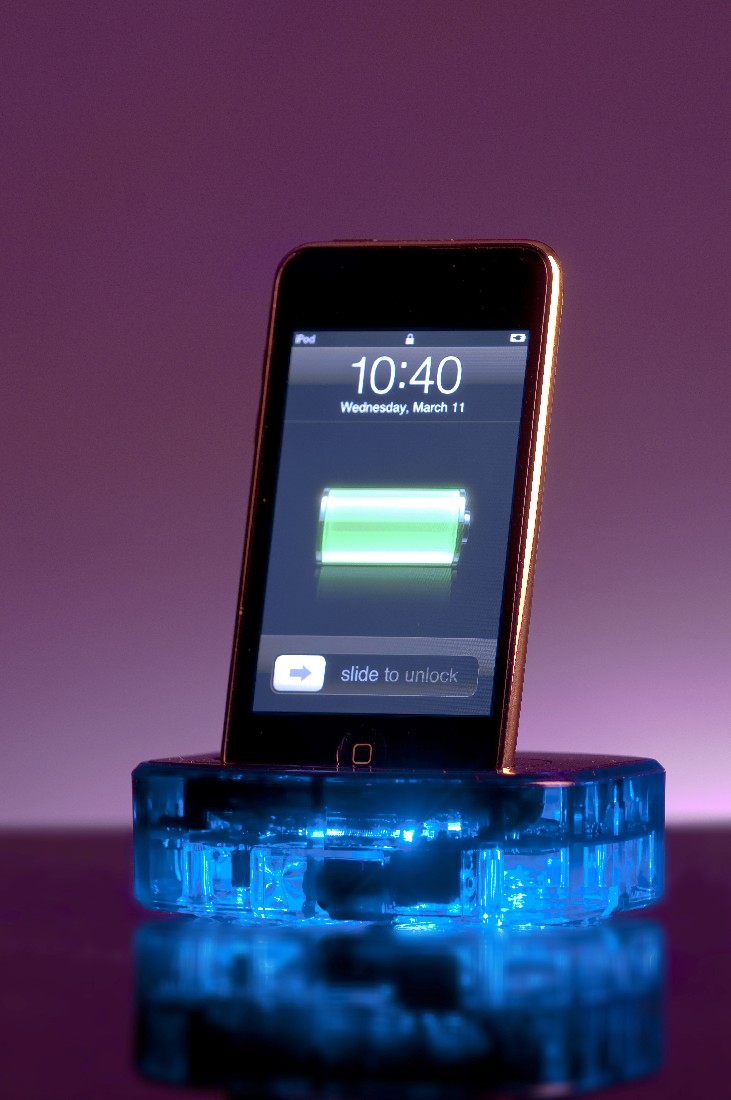

This is one of the more exciting accessories I’ve seen for the iPhone. I’ve always wanted to control my electronics through my iPhone ever since my mom’s old PDA could (years ago). With ThinkFlood‘s RedEye unit and free app, you can control your infrared electronics from your iPhone. Back then, my mom’s PDA could only control a device with line of site, but the RedEye unit is controlled via wifi and therefore can be controlled in any direction, across the room, in another room, or outside the house as long as you can reach your wifi network. Just simply place the RedEye unit within range of your electronics. The great thing is you can control multiple units in multiple rooms or multiple people can control a single unit (which may be a bad thing :]). Another great thing is you have the ability to program your own remote. Which means you choose the buttons and functions of the remote control and can change it based on the different activities you want to perform. The RedEye and accompanying application seem like a set of very impressive tools for you universal remote control needs.
Right now while the RedEye is going through their beta process, ThinkFlood is offering each RedEye unit at cost $119 instead of the normal retail price of $149. This seems like an even better reason to jump on the bandwagon before they raise their price. It will be really interesting to see how well the unit works and I will follow up with what I think about the device and the software. I should have mine by the 16th. 🙂
ThinkFlood :: What is RedEye?.

Check out something ridiculously cool from the WWDC 2009 conference. There Apple had a semi-live updating board that would pulsate each time someone purchased an app. Developers called it the pulsating app store hyperwall, and pulsate it did. The idea that you can see all of these purchases happening in semi-real time in a graphical way is pretty neat. Plus I’m sure if you did some calculations based on the board you could tell the number of downloads (purchases) a day and the popularity of the different apps.
AppleInsider | Apple stuns WWDC crowd with pulsating App Store hyperwall.
To get a better look at the different applications on the wall, someone has made a photosynthesis. It’s a collection of over 200 close-up pictures stitched together to make one high quality portrait.
What you’re looking at:
Over 3,000 apps – and growing – are downloaded every minute from the App Store. This is a live feed showing the activity of 20,000 popular apps currently on the store. Every time a customer downloads an app, its icon lights up (5-min. delay).
How we made it:
This hyperwall was built using the latest in Apple technology. It’s powered by 20 Mac Pro towers running Mac OSX Snow Leopard. It was programmed in Quartz Composer using Open L APIs. And it’s shown on 20 synchronized 30-inch Apple Cinema HD Displays.

AT&T’s CruiseCast was discontinued.
A pretty interesting new option in automotive entertainment but definitely an expensive one is AT&T‘s new service called CruiseCast. The idea is that you can mount a satalite receiver on top of your car and get TV in your car while traveling. This antena connects to a box which converts the stalite feed and then routes that to TVs mounted in your car.
In order to get the service you have to shell out around $1,300 and then pay a monthly fee of $28. You could buy each of your 4 kids a new 32GB iPhone 3G S and still have some money over to help pay off the additional data charges. They would be able to choose their content better and play video games on them when they get bored. The funny part is they advertise it as 40 channels plus which seems like just a portion of the channels that you get with a basic satellite package however 20+ of those channels are music channels which means nothing being that you have a radio or hopefully some way of playing your own music. However what is interesting is that they claim to have a coverage area of the whole entire United States. And in case you are traveling through a tunnel of in between New York City skyscrapers, the equipment buffers the video so that you can go 3 minutes without signal until you would know.


